

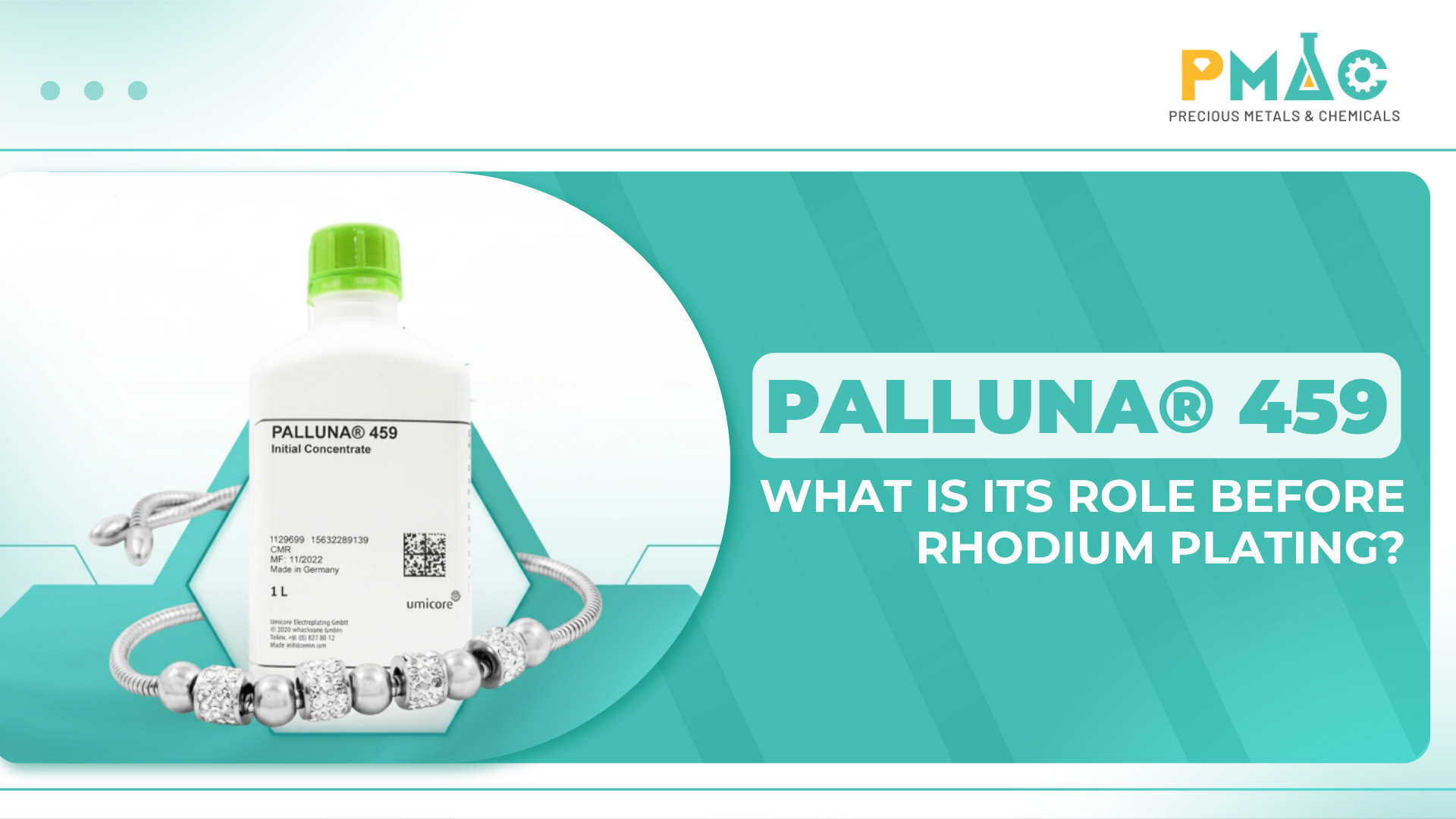
In a multilayer electroplating process, each coating layer performs a specific function to create a finished surface with an attractive color, suitable durability, and stable corrosion resistance. Rhodium is commonly used as the final coating due to its bright white color and high aesthetic appeal. However, to support the performance of the Rhodium coating, many plating processes incorporate an intermediate Palladium layer before Rhodium plating.
In this article, PMAC will help you understand:
- What is an intermediate Palladium layer?
- Why do many Rhodium plating processes use a Palladium layer?
- How does a diffusion barrier work?
- What role does PALLUNA® 459 play in creating a Pre-Palladium layer?
- When should businesses use a Palladium electrolyte before Rhodium plating?
I. What Is an Intermediate Palladium Layer?
In modern electroplating technology, particularly in jewelry plating, a finished coating system often consists of more than a single metal layer. Instead, many coating systems are designed with a multilayer structure in which each layer performs a specific function.
One of these important layers is the intermediate Palladium layer.
This layer is deposited using a Palladium electrolyte and is applied before Rhodium or certain other precious metal coatings. In many technical documents, it is also referred to as Pre-Palladium.
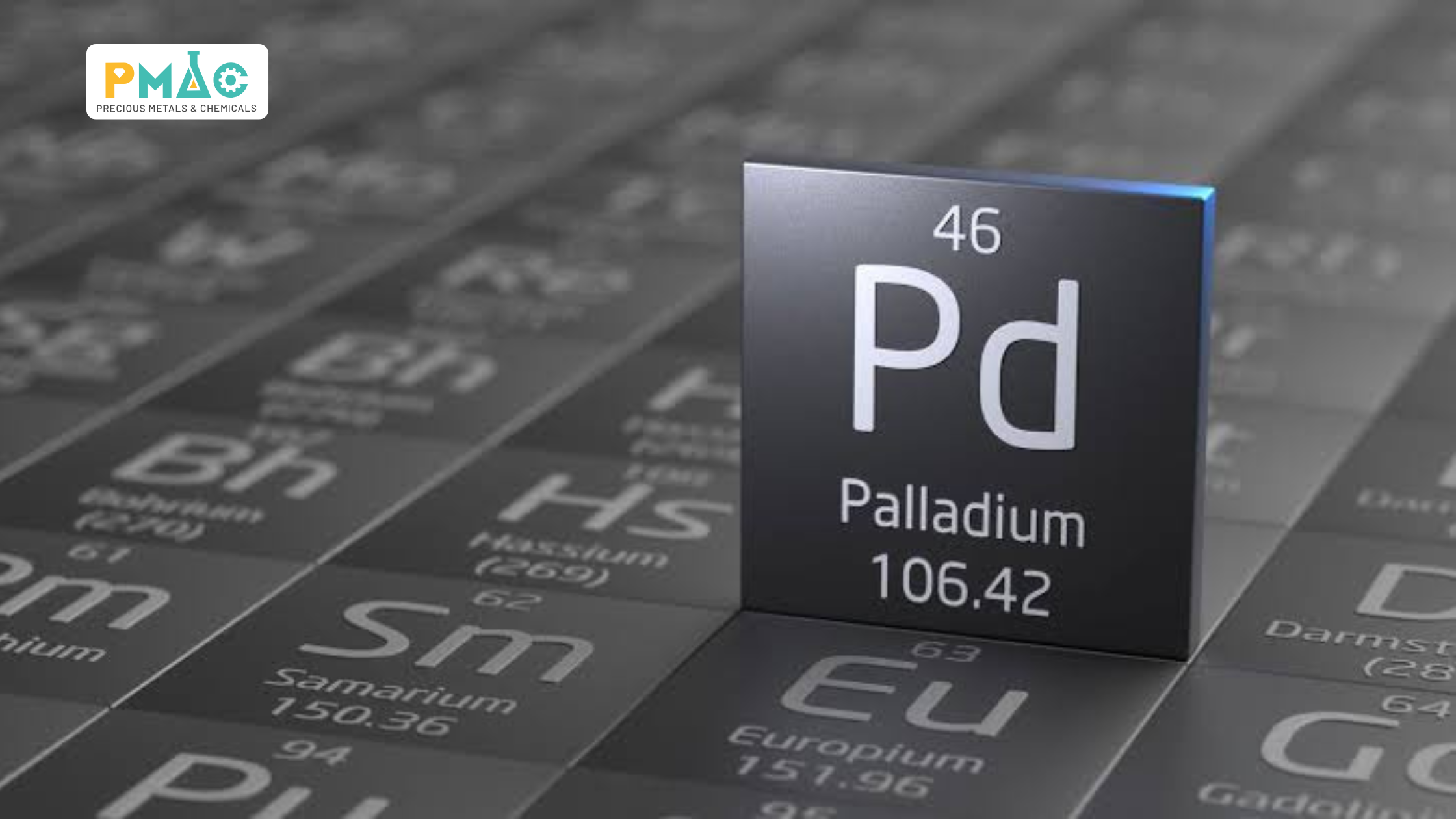
Figure 1: Palladium Metal
1. What Is Pre-Palladium?
Pre-Palladium is a Palladium layer deposited to an appropriate thickness before the final metal coating is applied.
In practical production, this layer is commonly used when businesses want to:
- Create a transition layer between different metal layers.
- Support the stability of the coating system.
- Create a diffusion barrier before Rhodium or Gold plating.
2. What Is a Diffusion Barrier?
In addition to being referred to as Pre-Palladium, the intermediate Palladium layer also serves as a Diffusion Barrier.
In multilayer electroplating systems, metal atoms may tend to diffuse between layers over time. If this occurs, the quality of the final coating may be affected.
A diffusion barrier is used to help limit this migration based on the principles of multilayer coating systems, thereby creating a more stable boundary between the substrate and the final coating.
For this reason, an intermediate Palladium layer is considered an important component in many electroplating processes that require high surface quality.
3. The Role of an Intermediate Palladium Layer in Multilayer Electroplating
A coating system may consist of multiple metal layers, each with a different function.
For example:
- The base layer provides adhesion.
- The intermediate layer supports coating system stability.
- The final layer provides color and aesthetic appearance.
The intermediate Palladium layer is positioned between these layers, acting as a transition layer and a diffusion barrier before Rhodium or Gold plating.
This allows businesses to develop electroplating processes that meet the surface quality requirements of products such as jewelry, watches, and high-end accessories.
Read more: What Is Palladium Plating? Applications in the Jewelry Industry
II. How Does PALLUNA® 459 Work in the Electroplating Process?
In many multilayer electroplating processes, a Palladium electrolyte is used not only to create a final coating but also to form an intermediate layer between the substrate and the final surface coating.
1. Creating a Pre-Palladium Layer Before Rhodium
One of the most important applications of PALLUNA® 459 is the creation of an intermediate Palladium layer before Rhodium plating.
In a multilayer coating system, the Pre-Palladium layer acts as a transition layer between the underlying layer and the final coating. This provides an additional supporting layer before the Rhodium coating is deposited on the outer surface.
This application is commonly found in products requiring a bright white color and uniform surface quality, such as jewelry, watches, and eyewear frames.
2. Acting as a Diffusion Barrier
In addition to serving as an intermediate layer, PALLUNA® 459 is designed to create a diffusion barrier.
According to the principles of multilayer coating systems, a diffusion barrier creates a boundary between different metal layers and helps limit the diffusion of substrate metals into the final coating.
In many Rhodium plating processes, this step is selected to help build a more stable coating system before the final surface layer is applied.
3. Creating a Bright White Palladium Finish
In addition to its role as an intermediate layer, PALLUNA® 459 can also be used to create a final Palladium coating.
According to technical information, the resulting coating offers:
- 99.9% pure Palladium.
- Bright white color.
- High gloss.
- Hardness of 230–250 HV.
- Good corrosion resistance.
This provides businesses with an additional option for applications requiring a bright white Palladium coating with an aesthetically appealing surface.
III. Key Advantages of PALLUNA® 459
In addition to creating an intermediate Palladium layer, PALLUNA® 459 offers several characteristics that help businesses develop more stable and flexible electroplating processes. Each characteristic provides specific value in production.
1. 99.9% Pure Palladium
PALLUNA® 459 produces a coating containing 99.9% pure Palladium. Its high purity makes the coating suitable for various applications requiring Palladium as either an intermediate layer or a final finish.
It also provides the foundation for creating a Pre-Palladium layer before Rhodium, in accordance with the intended design of the electrolyte.
2. Bright White Color
The Palladium coating produced by PALLUNA® 459 has a naturally bright white appearance.
This characteristic is suitable for products requiring a light-colored surface, including jewelry, watches, eyewear frames, and metal accessories. When used as a final coating, the color of Palladium can also meet the aesthetic requirements of various applications.
3. High Gloss
Gloss is an important factor for products with demanding appearance requirements.
The coating produced by PALLUNA® 459 has a high-gloss finish, contributing to a uniform and visually appealing surface after electroplating. For manufacturers, this helps support surface quality requirements in production.
4. Hardness of 230–250 HV
The Palladium coating produced by PALLUNA® 459 has a hardness of 230–250 HV.
This specification reflects the mechanical characteristics of the coating according to technical documentation and provides a basis for process engineers to determine whether the electrolyte is suitable for a particular application.
5. Good Corrosion Resistance
Palladium coatings offer good corrosion resistance.
When used as an intermediate layer in a multilayer coating system, this characteristic contributes additional protection to the overall coating structure. However, the overall performance still depends on the complete coating system and operating conditions.
6. High Ductility
In addition to its hardness, the coating also offers high ductility.
The combination of these characteristics makes the coating suitable for various applications that may require further processing or post-plating treatment, depending on each manufacturer’s production process.
7. Uniform Plating Performance
One notable characteristic of PALLUNA® 459 is its ability to produce a uniform coating.
In practical production, good current distribution helps the electrolyte deposit a more uniform coating on surfaces with different geometries. This is an important consideration for process engineers working with components featuring complex shapes.
8. Crack-Free Coatings up to 0.5 µm
PALLUNA® 459 can produce crack-free coatings up to a thickness of 0.5 µm.
This characteristic expands its application potential in processes requiring a Palladium layer of an appropriate thickness while maintaining coating integrity according to the published specifications.
9. Suitable for Both Rack and Barrel Plating
Not every electrolyte is suitable for multiple production methods.
PALLUNA® 459 is designed for both rack and barrel plating, allowing businesses to select the appropriate process based on product type, production scale, and desired productivity.
This flexibility is a notable advantage for manufacturers producing a wide range of products.
10. Easy Integration into Existing Processes
In addition to its coating characteristics, PALLUNA® 459 uses an ammoniacal electrolyte with clearly defined operating conditions in the technical documentation, including Palladium concentration, pH, temperature, current density, and suitable anode type.
The availability of detailed technical parameters makes it easier for process engineers to develop or optimize electroplating processes while providing a basis for consistent control of operating conditions.
IV. Applications of PALLUNA® 459
Thanks to its ability to create a Pre-Palladium layer, act as a Diffusion Barrier, and produce a final Palladium coating, PALLUNA® 459 is suitable for various industries requiring high surface quality.

Figure 2: Applications of PALLUNA® 459
1. Jewelry Plating
In jewelry electroplating, an intermediate Palladium layer is commonly used before Rhodium in multilayer coating systems.
Adding a Pre-Palladium layer helps complete the coating structure before the bright white Rhodium layer is deposited on the outer surface.
Palladium may also be used as a final white coating in applications where it meets the product requirements.
2. Watches
Metal components used in watches often require uniform color and high-quality surface finishes.
With its ability to produce a bright white Palladium coating, PALLUNA® 459 can be used in electroplating processes for watch components and cases, depending on each manufacturer’s process design.
3. Eyewear Frames
Eyewear frames often contain small components and complex geometries.
Thanks to its uniform plating performance, PALLUNA® 459 supports consistent coating deposition across surfaces with different shapes. This makes the electrolyte suitable for eyewear plating processes using either rack or barrel plating.
4. Writing Instruments
Products such as premium pens often require metal coatings with attractive colors and high-quality surface finishes.
In processes that use Palladium, PALLUNA® 459 can serve as either a final coating or an intermediate layer before Rhodium, depending on the selected multilayer coating structure.
5. Metal Accessories
Beyond the applications above, PALLUNA® 459 is suitable for various metal accessories that require a Palladium coating or an additional diffusion barrier before Rhodium or Gold plating.
The appropriate coating structure should be selected based on the substrate material, product requirements, and each manufacturer’s production process.
V. Technical Specifications of PALLUNA® 459
1. Operating Conditions
| Parameter | Value |
|---|---|
| Electrolyte | Ammoniacal |
| Palladium (Pd) content | 1.5–2 g/L |
| pH | 5.2–5.9 |
| Temperature | 25–30°C |
| Current density | Approx. 0.5 A/dm² |
| Plating rate | Up to 0.07 µm/min |
| Anode | MMO (Platinode® 167) |
2. Coating Properties
| Property | Value |
|---|---|
| Purity | 99.9% Palladium |
| Color | Bright white |
| Gloss | High |
| Hardness | 230–250 HV |
| Crack-free coating thickness | Up to 0.5 µm |
Read more: PALLUNA® 459
VI. Why Choose PALLUNA® 459 from PMAC?
Selecting the appropriate electrolyte depends not only on the product’s technical specifications but also on the ability to develop and optimize the overall electroplating process.
As a company specializing in electroplating and surface treatment solutions, PMAC provides customers with more than just products. PMAC also supports businesses throughout process implementation and operation.
Read more: From Product Samples to Electroplating Solutions: PMAC’s Consulting Process
When choosing PALLUNA® 459 from PMAC, businesses can benefit from:
- Genuine Umicore products with clear origins and reliable quality.
- Technical consultation based on the actual requirements of each electroplating process.
- Support in selecting the appropriate coating structure, including the use of Pre-Palladium and diffusion barrier layers when required.
- Assistance in optimizing plating bath operation and controlling process conditions according to technical documentation.
This approach enables PMAC to serve as a technical partner rather than simply a supplier of electroplating chemicals.
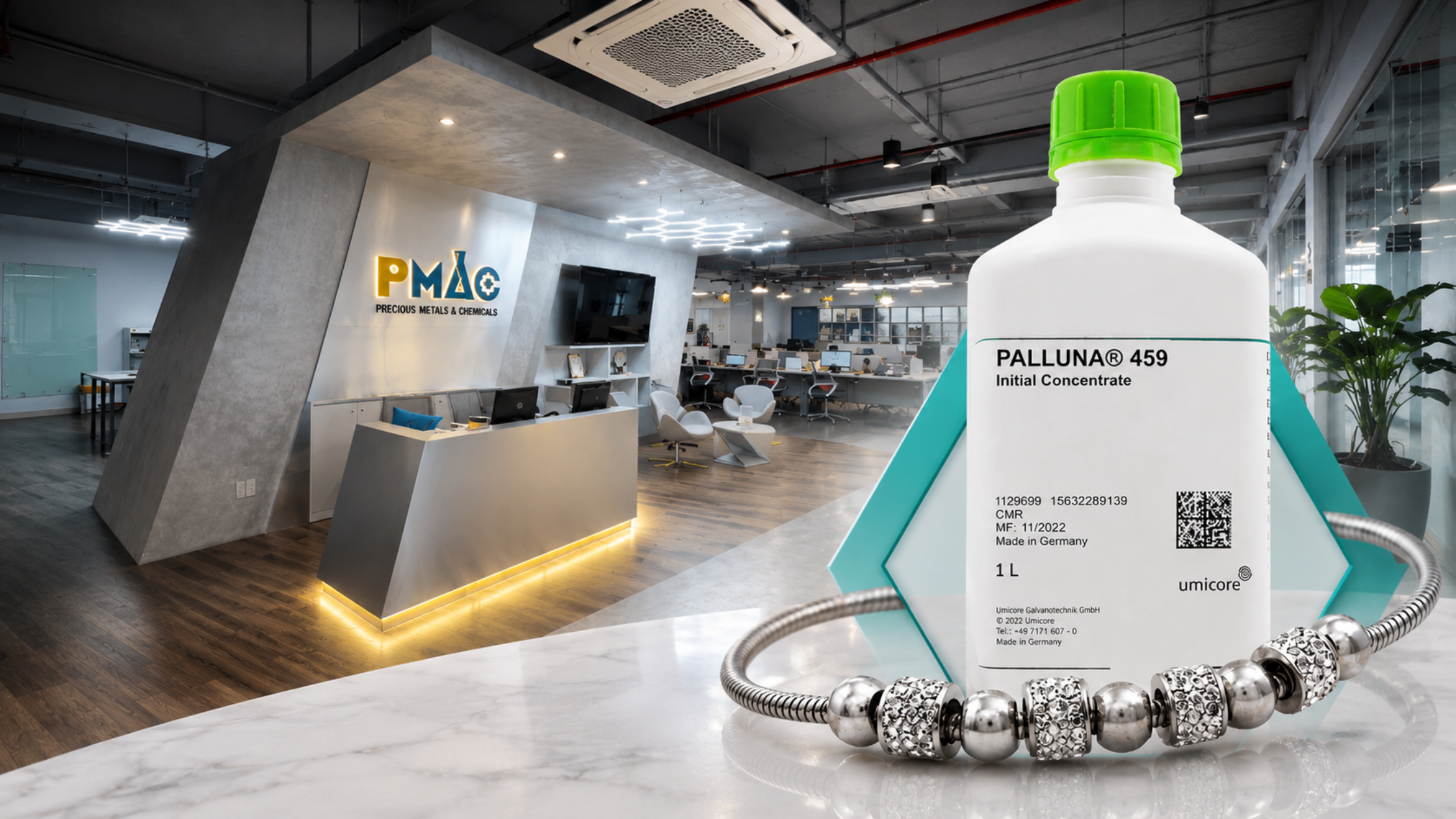
Figure 3: PMAC – Distributor of Umicore PALLUNA® 459
Buy PALLUNA® 459 from PMAC today!
Conclusion
In multilayer electroplating processes, an intermediate Palladium layer plays an important role in creating a transition layer before Rhodium or Gold plating. Through its functions as Pre-Palladium and a Diffusion Barrier, the Palladium layer contributes to the development of a more stable coating system based on the principles of multilayer electroplating technology.
According to technical documentation from Umicore Metal Deposition Solutions, PALLUNA® 459 is a Palladium electrolyte capable of producing a 99.9% pure Palladium coating while serving three functions in a single product: creating a Pre-Palladium layer, acting as a diffusion barrier, and producing a bright white final Palladium coating.
For businesses in the jewelry, watch, eyewear, and metal accessories industries, selecting the right electrolyte is an important step in developing an electroplating process that meets specific product requirements.
If your business is looking for a Palladium plating solution before Rhodium or requires technical consultation on intermediate Palladium layers, PMAC’s technical team is ready to help you select a suitable process and provide a quotation for genuine PALLUNA® 459 from Umicore.
CONTACT US
PMAC Joint Stock Company
Ho Chi Minh City: High-Tech Center, 4th Floor, HUTECH Building, D1 Street, Saigon Hi-Tech Park, Tang Nhon Phu Ward, Ho Chi Minh City
Hanoi: No. 22B O2, Linh Dam Peninsula, Hoang Liet Ward, Hanoi
Hotline: 0387 235 878
Fanpage: PMAC