



Uneven gold plating is one of the issues that can directly affect surface quality, aesthetic appearance, and the consistency of products after electroplating. The defect may appear in various forms, such as color variations, uneven bright and dark areas, or differences in coating appearance across different areas of the same product.
However, the same surface appearance does not necessarily indicate the same root cause. The defect may be related to the plating solution, operating conditions, electrical system, electrical contact, current distribution, agitation, or surface pretreatment. In many cases, multiple factors may simultaneously affect coating quality.
Therefore, troubleshooting uneven gold plating should not begin by changing multiple parameters or adding chemicals based solely on experience. A systematic diagnostic process should begin with the defective sample, operating data, and the entire production system.
In this process case study, PMAC presents a five-step approach to uneven gold plating:
Receive the Sample → Inspect the Sample → Inspect the Production System → Identify the Root Cause → Resolve the Defect
I. What Does Uneven Gold Plating Look Like?
1. Definition
Uneven gold plating refers to a condition in which the electroplated surface does not achieve the desired uniformity in color, surface appearance, or coating distribution.
Depending on the product and the gold plating process, the defect may appear in a specific area or as differences among multiple products within the same production batch.
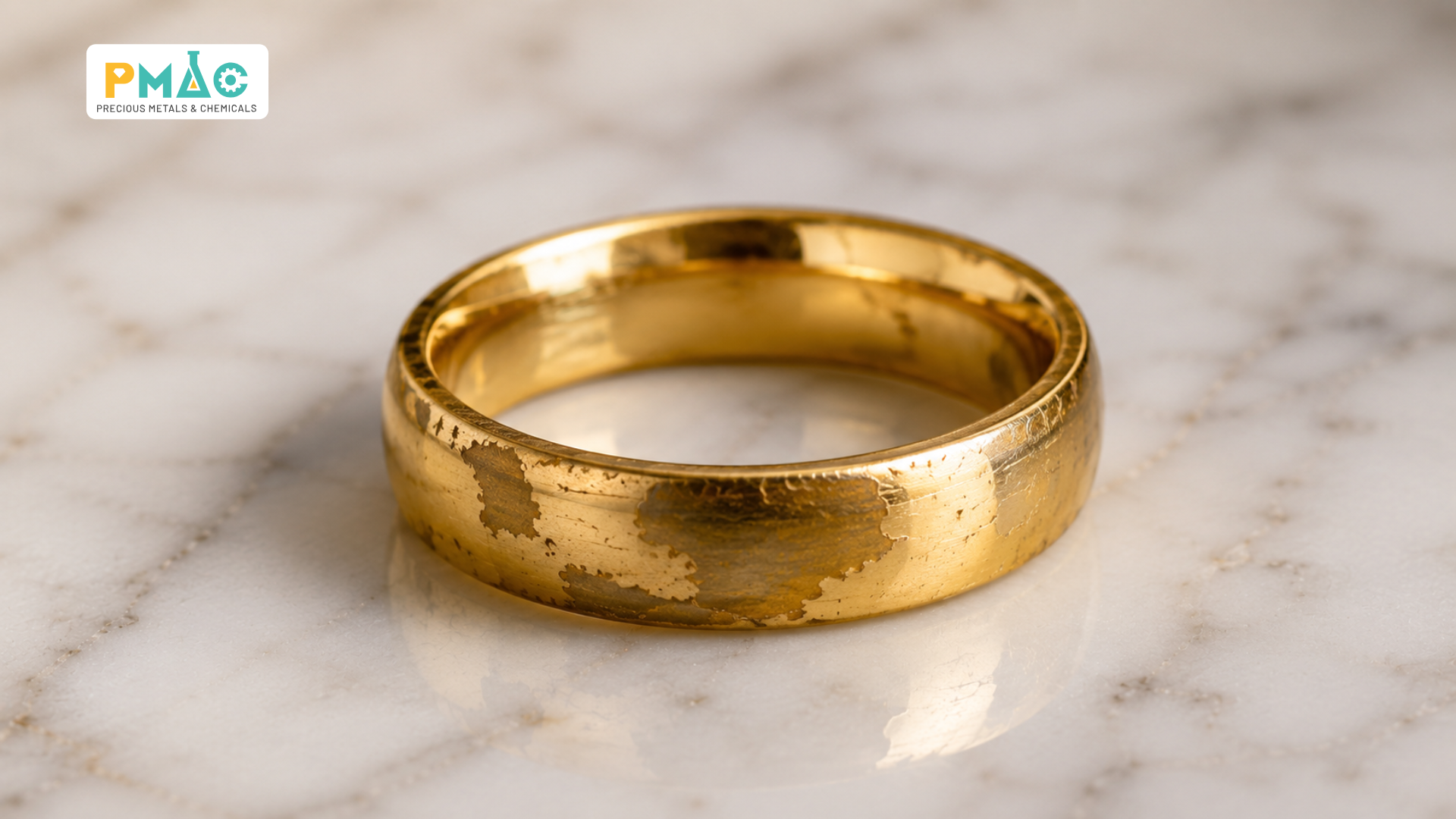
Figure 1: Uneven Gold Plating
Read more: What Is Gold Plating? Applications of Gold Plating in Jewelry Manufacturing
2. Signs of Uneven Gold Plating
Some common signs observed during sample inspection include:
- Differences in gold color across different areas of the same product.
- Certain areas showing a different coating appearance from the rest of the surface.
- Defects concentrated around edges, corners, recessed areas, or specific regions of the product.
- Different levels of coating uniformity among products within the same batch.
These observations are indicators that help guide the inspection process; they are not sufficient evidence to determine the root cause.
For example, a color difference in a particular area may be related to the electrochemical conditions at that location. However, electrical contact, product positioning, solution circulation, or the quality of the surface before plating may also need to be investigated.
If conclusions are based solely on visual inspection, the troubleshooting process can easily move in the wrong direction.
Read more: Why Does Plating Quality Vary? Common Causes Explained
II. How Does Uneven Plating Affect Production?
In decorative electroplating, particularly for jewelry and other products with demanding appearance requirements, even minor differences in color or surface uniformity may cause a product to fail quality inspection.
In production, plating defects may lead to:
- A higher percentage of products requiring repair or replating.
- Additional costs for chemicals, labor, and energy.
- Longer production times.
- Delays in delivery schedules.
- Reduced consistency between production batches.
- Greater difficulty for QC/QA teams in maintaining quality control.
Importantly, if the actual root cause has not been identified, replating the product may not necessarily solve the problem. The same defect may continue to appear in subsequent batches if the condition causing the instability remains within the electroplating system.
Therefore, the objective of troubleshooting is not simply to repair one defective sample. More importantly, it is necessary to identify which factor within the process is causing instability and bring that factor under control.
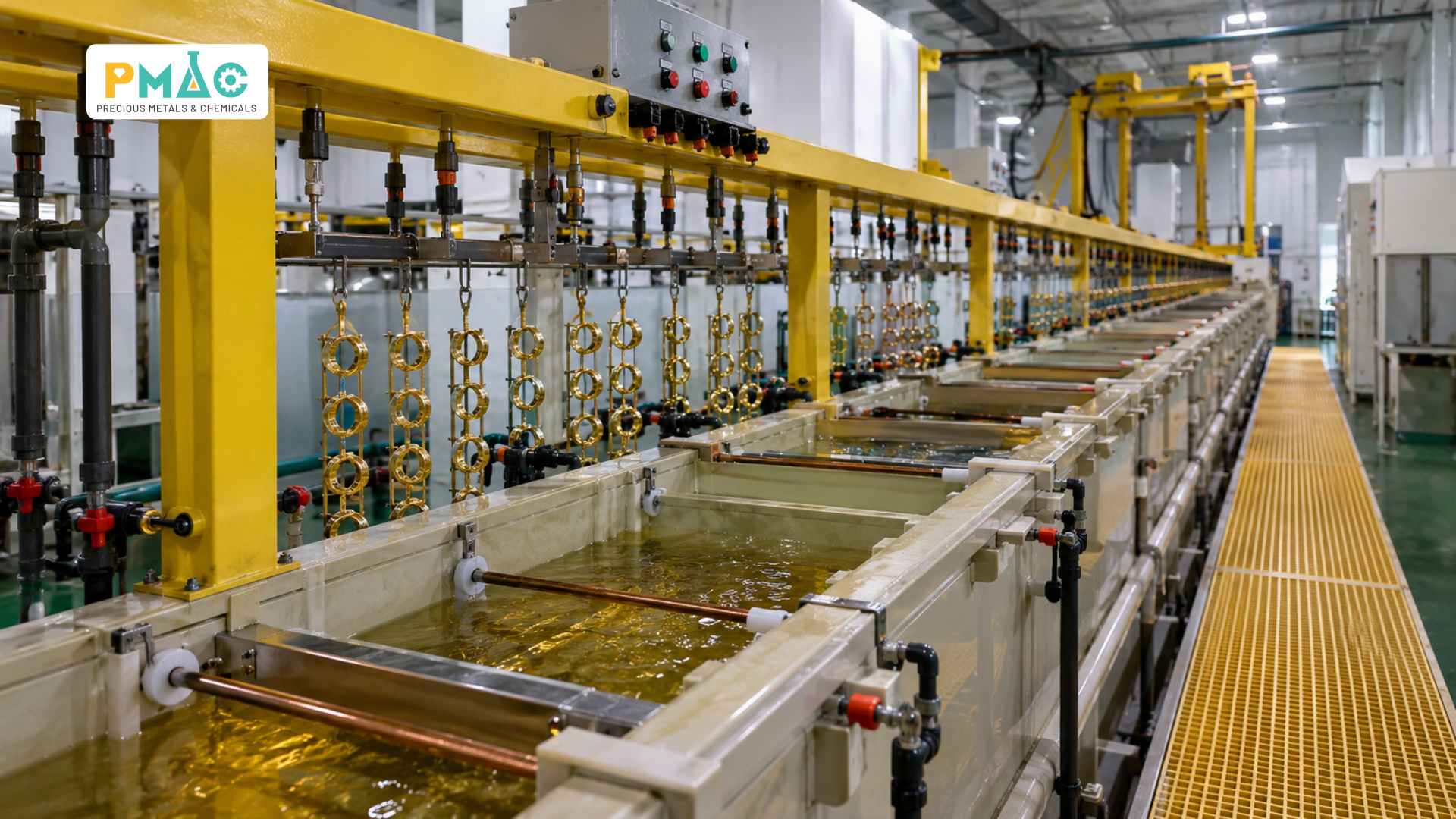
Figure 2: Gold Electroplating System
III. Why Should Uneven Gold Plating Not Be Troubleshot by Trial and Error?
When uneven gold plating is detected, a common reaction is to immediately adjust a parameter believed to be related to the problem. Operators may change the current, increase the plating time, adjust the temperature, or add components to the plating solution.
This approach may sometimes produce a visible change in the product. However, if the root cause has not been identified, temporary improvement does not necessarily mean that the problem has been solved.
1. One Defect Can Have Multiple Possible Causes
In electroplating, coating quality results from the interaction of many factors. The plating solution is only one part of the overall system.
When a plating defect occurs, the groups of factors that may need to be investigated include:
- Plating solution composition and condition.
- pH and operating temperature.
- Current density.
- Plating time.
- Power supply system.
- Electrical contact.
- Anode condition.
- Jigs/racks.
- Product positioning in the plating bath.
- Solution agitation or circulation.
- Surface pretreatment process.
Therefore, the same uneven coating appearance may require several groups of factors to be examined before the primary cause can be identified.
2. Changing Multiple Parameters at Once Makes Root Cause Analysis More Difficult
One important principle in electroplating troubleshooting is to avoid changing too many variables simultaneously.
For example, if temperature, current, plating time, and solution composition are all adjusted at the same time, the product may improve or deteriorate afterward. However, it becomes difficult to determine which factor actually caused the change.
This reduces traceability and may cause the process to remain dependent on trial-and-error adjustments.
In contrast, a systematic inspection method helps to:
- Accurately document the defect.
- Collect relevant operating data.
- Inspect each group of potentially influential factors.
- Compare operating data with the observed defect.
- Gradually narrow down the range of possible causes.
- Make adjustments only when there is an appropriate technical basis.
This approach is particularly important for defects that repeatedly recur or appear inconsistently between production batches.
IV. Case Study: PMAC’s Five-Step Process for Resolving Uneven Gold Plating
When receiving a case involving uneven gold plating, PMAC does not begin by assuming that the chemicals are responsible.
Instead, the inspection process starts with the defective sample and extends to all relevant factors within the production system.
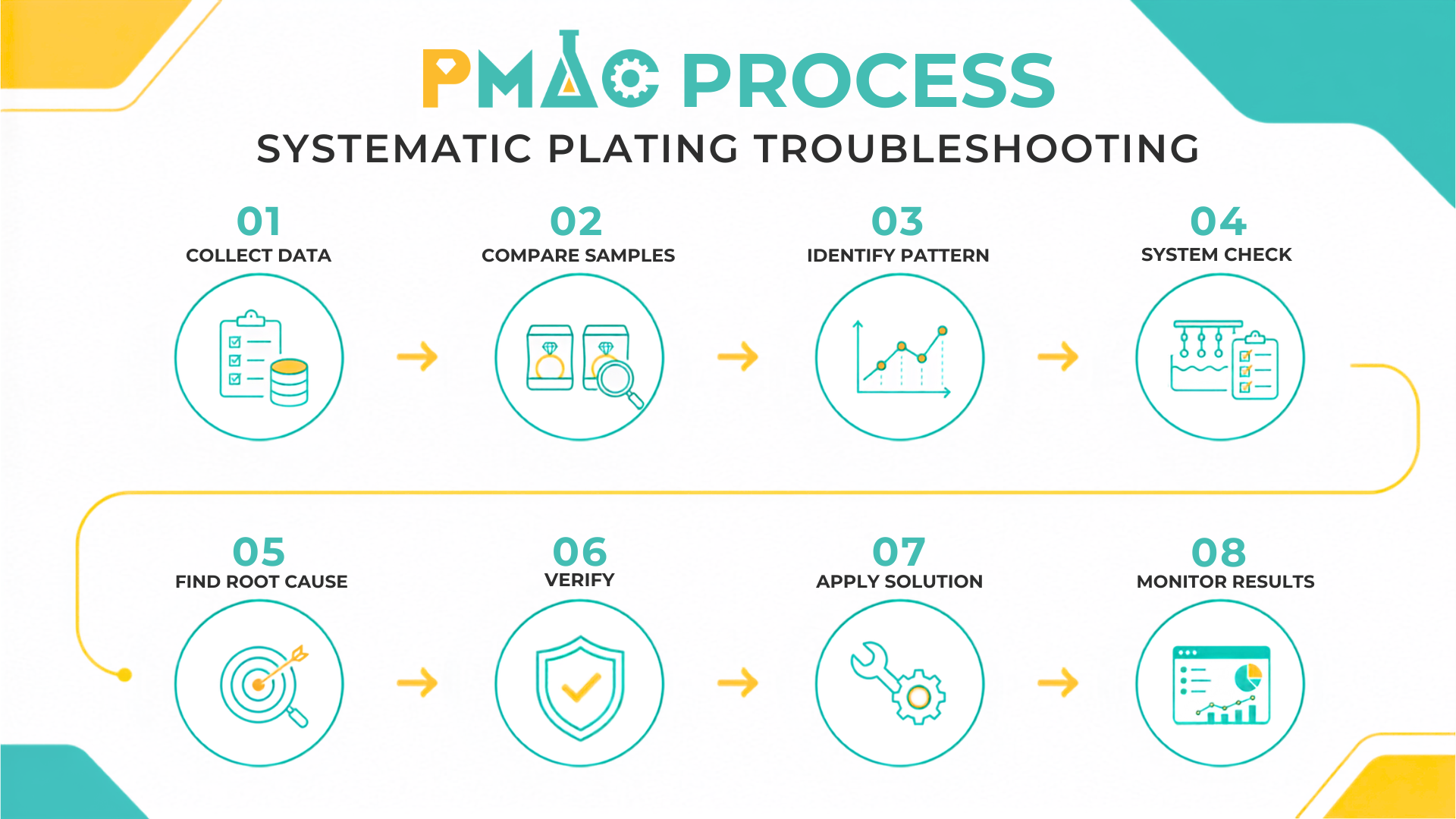
Figure 3: PMAC’s Process for Resolving Uneven Gold Plating
A key principle of this process is that the sample should not be separated from the production system.
A finished sample shows the result of the electroplating process. However, to understand why that result occurred, it is necessary to examine the complete set of conditions that created the coating.
Step 1: Receive the Sample and Initial Information
The first step in troubleshooting uneven gold plating is to receive the defective sample together with relevant production information.
Depending on the data available from the business, PMAC may collect information such as:
- Samples showing the defect.
- A description of the observed issue.
- When the defect first appeared.
- How frequently the defect occurs.
- The type of substrate material.
Collecting initial information helps establish the context of the problem. This provides a basis for narrowing the scope of the investigation rather than checking every possible factor without direction.
However, initial information is used only as a guide. PMAC does not use a single data point to determine the root cause. Instead, the information is further compared with the sample and production system during the following steps.
Step 2: Inspect the Defective Sample
After receiving the initial information, the sample is inspected to determine exactly how the uneven coating appears.
At this stage, the objective is not simply to confirm that the product is “defective.” The goal is to describe the defect as specifically as possible.
Factors that may be examined include:
- Where does the color variation appear?
- Do the bright and dark areas follow a particular pattern?
- Is the defect concentrated around edges, corners, recessed areas, or large surfaces?
- Do multiple products show the defect in the same location?
- How much variation exists among products within the same batch?
- Is the defect related to the product’s position on the jig or rack?
The location and pattern of the defect can help indicate which groups of factors should be prioritized during the investigation.
However, PMAC does not determine the root cause based solely on surface appearance. The sample inspection results must therefore be used as part of a broader dataset and compared with the plating solution, operating parameters, electrical system, agitation, and surface pretreatment process.
Step 3: Inspect the Entire Production System
After documenting the defect on the sample, the next step is to inspect the relevant factors within the electroplating system.
This stage is important because coating quality depends not only on the plating solution but also on operating conditions, equipment, electrical contact, product positioning, and pretreatment.
The objective is not to inspect individual factors randomly. PMAC evaluates groups of items systematically, collects data, compares the findings with the observed defect, and gradually narrows down the range of possible causes.
The inspection may include:
- Checking the condition of the plating solution.
- Checking pH and temperature.
- Checking current density and plating time.
- Checking the electrical system and electrical contact.
- Checking the anodes.
- Checking the agitation or solution circulation system.
- Checking the surface pretreatment process.
Step 4: Compare the Data and Identify the Root Cause
After inspecting the sample and the production system, PMAC compares the collected data.
This process may include evaluating:
- The appearance and location of the defect on the sample.
- The timing and frequency of the defect.
- Operating data.
- Plating solution condition.
- Electrical conditions.
- Jigs/racks and electrical contact.
- Agitation or circulation systems.
- Surface pretreatment processes.
A plating defect may result from a single factor or from the combined effects of several factors.
Therefore, identifying the root cause of uneven gold plating should be based on data rather than assumptions derived from a single symptom.
Accurately identifying the cause helps businesses avoid making adjustments in the wrong direction and provides a basis for selecting the appropriate solution in the next step.
Step 5: Propose Solutions and Monitor Results
Once the root cause or related group of factors has been identified through inspection, PMAC proposes an appropriate corrective approach.
Depending on the actual situation, the solution may involve:
- Adjusting operating conditions.
- Re-establishing control over the plating solution.
- Improving electrical contact.
- Inspecting or adjusting jigs/racks.
- Changing product positioning in the plating bath.
- Inspecting the agitation or circulation system.
- Optimizing surface pretreatment.
- Monitoring samples after corrective actions are implemented.
The core principle is to identify the correct cause before changing the process.
Changing chemicals or adjusting multiple parameters through trial and error may introduce additional variables. This not only makes troubleshooting more complex but also makes it more difficult to evaluate the actual impact of each change.
After corrective actions are implemented, samples should continue to be monitored and evaluated.
The objective is not only to determine whether one product has improved but also to verify whether process stability can be maintained.
V. Common Groups of Factors Investigated When Gold Plating Is Uneven
There is no fixed list of causes that applies to every case of uneven gold plating. Each electroplating system has different operating conditions, equipment, products, and quality requirements.
However, the diagnostic process generally examines several major groups of factors:
| Factor Group | Items to Inspect | Purpose |
|---|---|---|
| Plating solution | Solution condition, component concentrations, pH | Evaluate the chemical condition of the bath |
| Operating conditions | Temperature, current density, plating time | Assess process stability |
| Electrical system and contact | Power supply, electrical paths, contact points | Evaluate the stability of current delivery |
| Jigs/racks and product positioning | Position, spacing, orientation, contact points | Examine factors related to current distribution and product position |
| Agitation and circulation | Operating condition, solution flow | Evaluate the uniformity of conditions within the bath |
| Surface pretreatment | Cleaning, activation, and other pretreatment steps | Assess surface consistency before coating deposition |
The table above is a technical inspection framework. It does not imply that all these factors are responsible for every specific case.
1. Factors Related to the Plating Solution
The plating solution should be evaluated according to the parameters appropriate for the chemical system being used.
Solution composition, pH, and operating condition are among the data that should be reviewed when a defect occurs.
However, focusing only on chemicals may cause problems outside the plating bath to be overlooked. Even a properly controlled solution cannot fully compensate for poor electrical contact, unsuitable product positioning, or inconsistent pretreatment.
Read more: How to Choose Electroplating Chemicals for Your Production Line
2. Factors Related to Operating Conditions
Operating parameters should be controlled and monitored throughout production.
It is important to consider not only the set values but also whether these parameters remain stable over time.
During evaluation, operating data should be compared with the time at which the defect occurred to identify any relevant changes or abnormalities.
3. Factors Related to the Electrical System and Contact
Electroplating directly depends on the ability to deliver electrical current to the product.
Therefore, the power supply, electrical paths, and contact points are all important items to inspect.
If coating quality differs between products or between positions on the same rack, electrical contact is one of the groups of factors that should be included in the investigation.
4. Factors Related to Jigs/Racks and Product Positioning
Two products using the same plating solution and the same operating settings may still experience different electrochemical conditions if they are positioned differently.
Therefore, product arrangement should be considered part of the process.
Spacing, orientation, and position within the plating bath can provide important data when analyzing uneven coating.
5. Factors Related to Agitation and Circulation
The agitation or circulation system must maintain conditions appropriate for the process.
Inspection helps determine whether the solution is circulating properly around different areas of the product.
This is one reason why troubleshooting should be conducted on the actual production system rather than relying solely on a finished sample.
6. Factors Related to Surface Pretreatment
Coating quality begins with the quality of the substrate surface.
If cleaning or surface preparation before plating is inconsistent, the final plating result may also vary.
Therefore, when defects continue to recur even after the plating bath has been inspected, the pretreatment process is one of the areas that should be carefully evaluated.
VI. What Makes PMAC’s Electroplating Troubleshooting Approach Different?
PMAC’s approach focuses on treating plating defects as an issue involving the entire production system rather than assuming that every abnormality originates from the chemicals.
1. From Sample Inspection to the Entire Production System
The sample provides information about how the defect appears. The production system provides the data needed to explain why the defect may have occurred.
Combining these two sources of information provides a stronger basis for diagnosis than examining only the product or a single operating parameter.
2. Looking Beyond the Chemicals
Chemicals are an important part of the electroplating process, but they are not the only factor determining coating quality.
The electrical system, jigs/racks, electrical contact, product positioning, agitation, and pretreatment can all affect the final result.
Therefore, the scope of inspection must be broad enough to avoid overlooking relevant factors.
3. Identifying the Root Cause Before Making Adjustments
PMAC prioritizes collecting and comparing data before recommending changes.
This approach helps avoid adjusting multiple parameters simultaneously, reduces the number of new variables introduced into the process, and provides a clearer technical basis for troubleshooting plating defects.
4. Proposing Solutions Based on Actual Conditions
There is no single troubleshooting formula for every case of uneven gold plating.
The solution must be based on the product type, the existing system, the defect pattern, and the identified root cause.
This allows businesses to focus on the factors that actually require adjustment rather than changing the entire process.
5. Monitoring Results After Corrective Actions
An adjustment is only meaningful when its results can be evaluated and monitored.
Therefore, technical support does not necessarily end immediately after a corrective action is recommended.
Evaluating samples after adjustments helps verify effectiveness and supports further optimization of the electroplating process.
6. When Should Businesses Use Electroplating Technical Consulting Services?
Not every surface defect requires a complex analysis process. However, businesses should consider specialized technical support when the issue begins to affect production stability.
Situations that commonly require systematic investigation include:
- Plating defects repeatedly recur.
- Multiple adjustments have been made without identifying the root cause.
- Quality varies between production batches.
- The defect rate or rework rate is increasing.
- A defect appears only in specific positions or at certain times.
- The process depends heavily on the individual experience of operators.
- The business needs to optimize the electroplating process to improve stability.
When defects continue to recur, trying multiple different solutions may increase costs without creating a stable process.
In such cases, electroplating technical consulting helps businesses restructure their approach to the problem: from describing the defect and collecting data to inspecting the system, identifying the root cause, and evaluating corrective actions.
VII. Electroplating Technical Consulting Services at PMAC
In addition to supplying electroplating chemicals and surface technology solutions, PMAC supports businesses in analyzing and resolving production issues.
Depending on the actual situation, the support process may include:
- Receiving samples and information about the defect.
- Evaluating the defect appearance on the product.
- Analyzing the current electroplating process.
- Inspecting groups of potentially related factors.
- Supporting the process of narrowing down and identifying the root cause.
- Recommending corrective actions based on actual conditions.
- Monitoring adjustments and optimization.
The objective of technical consulting is not simply to repair a defective product.
More importantly, it is to help businesses understand which factors are affecting the process and develop more appropriate control methods.
By taking an approach that extends from the sample to the entire production system, PMAC aims to help businesses solve problems based on data and actual operating conditions.
PMAC CX HUB: One Touchpoint for Electroplating and Jewelry Material Consultation
Conclusion
Uneven gold plating can result from multiple factors within the same electroplating system. The plating solution, operating conditions, electrical system, electrical contact, jigs/racks, agitation, and surface pretreatment must all be considered in relation to the actual defect observed on the product.
Therefore, troubleshooting should not begin by changing multiple parameters at once. The starting point should be to correctly define the problem, collect sufficient data, and systematically identify the root cause.
PMAC’s five-step process—
Receive the Sample → Inspect the Sample → Inspect the Production System → Identify the Root Cause → Resolve the Defect
—helps businesses approach plating problems systematically, reduce reliance on trial and error, and establish a foundation for long-term process optimization.
If your business is experiencing uneven gold plating, recurring plating defects, or an electroplating process that has not achieved the desired level of stability, PMAC can support the investigation, analyze relevant factors, and recommend corrective actions based on actual production conditions.
PMAC Joint Stock Company
Ho Chi Minh City: High-Tech Center, 4th Floor, HUTECH Building, D1 Street, Saigon Hi-Tech Park, Tang Nhon Phu Ward, Ho Chi Minh City
Hanoi: No. 22B O2, Linh Dam Peninsula, Hoang Liet Ward, Hanoi
Hotline: 0387 235 878
Fanpage: PMAC