

Silver salts are among the most essential components used in modern silver electroplating, playing a decisive role in everything from surface quality to durability, electrical conductivity, and coating stability. In this article, PMAC provides an in-depth analysis of their function in electroplating technology, the key advantages of silver cyanide salts, and their practical applications across today’s manufacturing industries.
I. What is silver salt?
Silver salts are inorganic compounds in which silver ions (Ag⁺) bond with an anion to form a stable salt. These compounds possess distinctive chemical properties that enable their wide use across various industries. Notably, silver salts can be easily reduced to metallic silver—a critical characteristic that underpins their applications in electroplating, silver recovery from solutions, and the production of silver materials and bullion.
II. Why is silver salt needed in electroplating?
In the silver-plating process, silver salts play a central role in forming a bright, highly adhesive, and stable coating. Beyond serving as the primary source of silver, they fundamentally influence the mechanical properties, chemical behavior, and long-term durability of the plated layer.
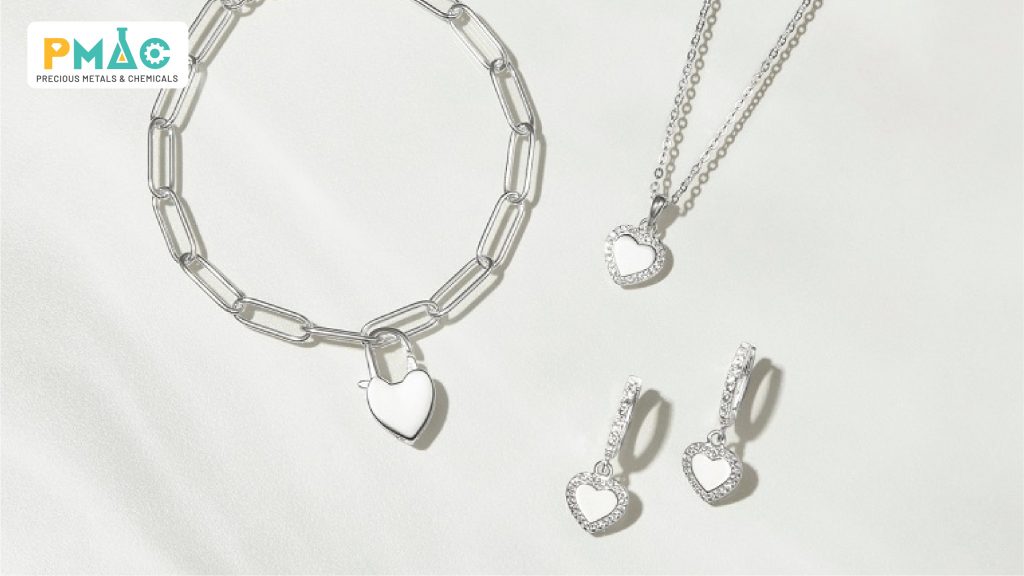
Figure 1: Silver salts play a crucial role in enhancing the brightness and gloss of the plated surface
Below are three key reasons why silver salts are indispensable in electroplating:
1. Provides silver Ions (Ag⁺) for the plating process
Silver salt serves as the primary source of Ag⁺ ions in a silver-plating bath. During electrolysis, Ag⁺ ions migrate to the cathode and are reduced to metallic silver (Ag⁰), forming a strong, uniform, and well-adhered plated layer.
The concentration of Ag⁺ must be kept stable to ensure the reduction process occurs at the correct rate. If Ag⁺ is insufficient, the coating may become rough, porous, or burnt at the edges. Conversely, if Ag⁺ is excessive, silver crystals grow uncontrollably, leading to discoloration and reduced adhesion.
For this reason, silver salts play a critical role in maintaining ion balance and electrochemical stability throughout the entire plating process.
2. Influences the quality of the plated layer
The quality of a silver plating layer — including brightness, smoothness, adhesion, and color – depends greatly on the purity of the silver salt as well as the stability of Ag⁺ ions in the solution.
High-purity silver salts help minimize metallic impurities such as Cu²⁺, Pb²⁺, or Zn²⁺, which are common causes of tarnishing, surface pitting, or coarse deposits. In addition, silver salts interact with additives such as brighteners, levelers, and complexing agents to control crystal morphology (grain structure), resulting in a mirror-bright, smooth, and uniform silver deposit.
A high – quality silver salt source improves nucleation efficiency by increasing the number of fine crystal nuclei, thereby producing a flatter surface and a more aesthetically pleasing plating finish.
3. Ensures good conductivity and corrosion resistance
Silver is the metal with the highest electrical conductivity among all metals, but to achieve maximum performance, the plated silver layer must have a uniform and highly pure crystal structure.
High-quality silver salts help produce a silver coating with minimal crystal defects, reducing electron-scattering effects and thereby optimizing conductivity for critical components such as contacts, connectors, and electronic parts. In addition, a purer silver layer offers better resistance to oxidation and corrosion, allowing the product to retain its brightness and operate reliably in demanding environments.
Therefore, the quality of the silver salt not only affects the aesthetic appearance of the deposit but also determines the stability and service life of technical silver plating.
III. Potassium silver cyanide (KAg(CN)₂)
Potassium Silver Cyanide (PSC), commonly known as silver potassium cyanide, is a chemical compound containing up to 54.2% silver. The product is manufactured by Heraeus Holding and is supplied in 1000 g bags.
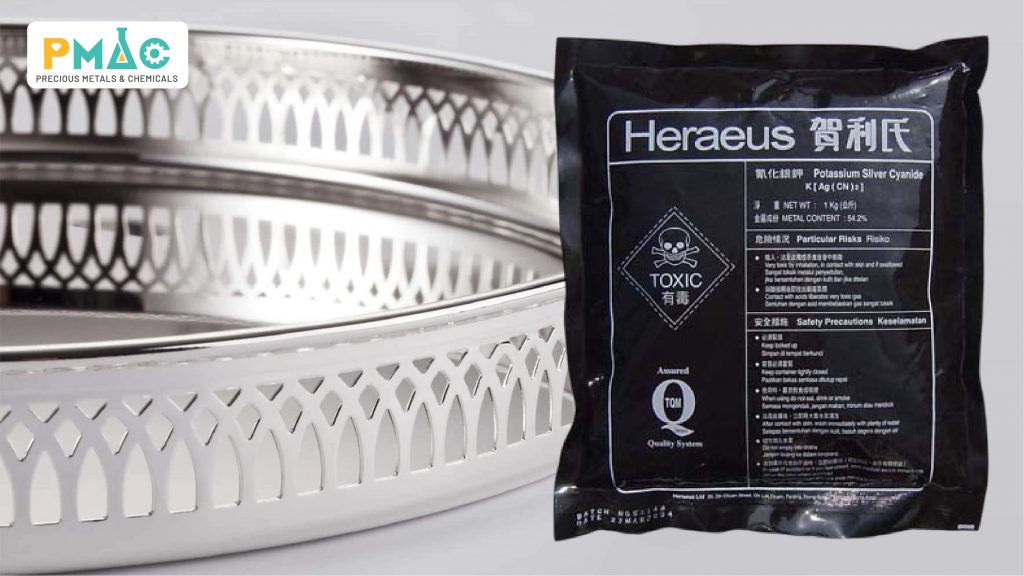
Figure 2: Heraeus silver salts
1. High quality plated coating
Potassium silver cyanide (KAg(CN)₂) is the standard choice for industrial silver-plating baths thanks to its ability to produce deposits with exceptional brightness, smoothness, and adhesion.
In cyanide electrolytes, silver is present mainly in the stable complex ion [Ag(CN)₂]⁻, which allows the reduction process to proceed slowly, uniformly, and in a highly controlled manner. This results in ultra-fine silver crystals and a mirror-bright, homogeneous coating even on complex geometries.
Silver deposits produced from cyanide-based salts also exhibit superior adhesion compared to many non-cyanide systems, making them ideal for high-performance applications such as jewelry, electronic components, and technical silver plating.
2. Long term bath stability
One of the major advantages of cyanide-based silver salts is their ability to produce exceptionally stable plating baths.
The cyanide complex keeps the Ag⁺ concentration in equilibrium, minimizing precipitation and significantly reducing pH fluctuations during operation. Baths formulated with potassium silver cyanide have a long service life, are less prone to contamination, and greatly reduce common defects such as pitting, burning, or coarse crystallization.
Thanks to this stability, manufacturers can operate their baths for extended periods with minimal maintenance, reducing costs related to upkeep, chemicals, and labor.
3. Easy process control
An important advantage of potassium silver cyanide is its ability to provide highly controllable plating conditions, making it ideal for large-scale production and applications that require precise deposition.
Thanks to the stability of the cyanide complex, the Ag⁺ concentration remains consistent, allowing operators to easily adjust key parameters such as current density, temperature, diffusion rate, and deposition efficiency. Cyanide-based baths also interact effectively with additives such as brighteners, levelers, and anti-burning agents, optimizing crystal morphology and enhancing surface brightness.
Routine analyses—including silver titration, free cyanide measurement, and monitoring of electrolytic efficiency—are straightforward to perform, helping reduce defects and ensuring consistent, high-quality silver deposits.
IV. Applications of potassium silver cyanide in industry
1. Jewelry plating
In the jewelry industry, potassium silver cyanide (KAg(CN)₂) is widely used due to its ability to produce highly lustrous, well-adherent, and finely textured silver deposits. It is considered the optimal choice for high-end silver products, 925 silver, and intricate decorative components that require precision and refinement.
Thanks to its stable color tone, excellent resistance to tarnishing, and strong anti-oxidation properties, this silver salt helps enhance the durability, appearance, and long-term aesthetic value of finished jewelry pieces.

Figure 3: The role of silver salts in industry
2. Electronics plating
In the electronics industry, potassium silver cyanide is a critical component for depositing silver onto connectors, circuit boards, conductors, and electrical contact points.
Silver coatings produced from KAg(CN)₂-based electrolytes offer exceptionally high electrical conductivity and outstanding corrosion resistance, ensuring optimal signal transmission performance.
Additionally, the durable, thin, and uniform silver layer protects components, reduces contact resistance, and enhances the overall reliability and longevity of electronic devices.
3. Industrial plating
Potassium silver cyanide is widely used in industrial applications for coating components that require high electrical conductivity, wear resistance, and load-bearing capacity, such as machine shafts, electrical conductors, and precision mechanical parts.
Silver-plating baths containing KAg(CN)₂ allow for highly uniform deposition, minimizing porosity and preventing pitting, while producing a durable and strongly adherent silver layer.
This enhanced coating quality improves the durability, operational stability, and overall performance of equipment operating under demanding industrial conditions.
4. Medical plating
Potassium silver cyanide is also used for silver plating medical devices such as surgical instruments, joint components, probes, and various sensing equipment.
Silver provides natural antimicrobial properties and excellent resistance to biological corrosion, helping maintain a sterile and safe environment.
The silver layer deposited from KAg(CN)₂ offers high purity, exceptional stability, and full compliance with medical safety standards, making it suitable for critical healthcare applications.
V. Where to buy high quality silver salt?
With many years of experience and a highly skilled technical team, PMAC is proud to be a leading partner of Umicore (Germany) in Vietnam.
Equipped with advanced machinery and a strictly controlled quality management system, PMAC is committed to delivering comprehensive, safe, and efficient solutions for businesses in the industrial, jewelry, electronics, and medical sectors.
Beyond supplying precious materials such as gold, silver, palladium, rhodium, platinum, and gold salts, PMAC also provides composition analysis, scrap refining services, and consultation on precious-metal storage according to international standards.
Conclusion
Silver salts—particularly the potassium cyanide form (KAg(CN)₂)—play an essential role in producing high-quality silver coatings that are durable, bright, and electrochemically stable.
Thanks to their strong complexing ability and high purity, cyanide-based silver salts have become the optimal choice across modern industries such as jewelry, electronics, mechanical engineering, and medical devices.
To achieve the best plating performance, businesses not only need high-grade chemicals but must also source them from reputable and technically capable suppliers. With strong technical expertise, extensive industry experience, and partnerships with global leaders such as Umicore, PMAC is a trusted provider of silver salts and precious-metal materials in the Vietnamese market.
Choosing the right silver salt is the first step toward elevating product quality and maximizing operational efficiency throughout the entire plating process.
Learn more:
https://web.pmac.asia/shop/product/arguna-et-p-bright-silver-electrolyte-805