

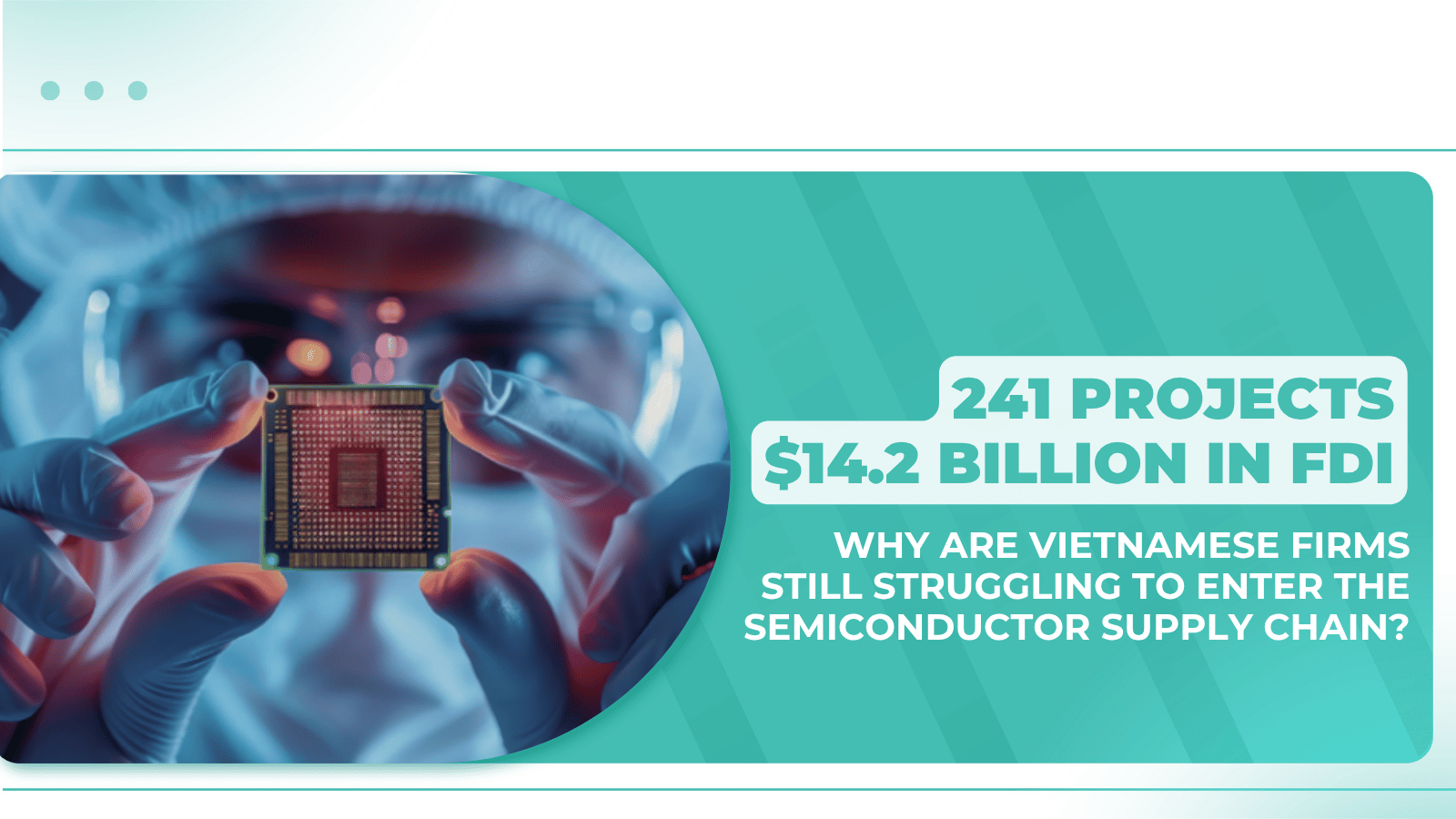
Vietnam is attracting a growing number of semiconductor projects. By March 2026, the country had recorded 241 semiconductor FDI projects with total registered capital exceeding US$14.2 billion, alongside more than 50 chip design companies and approximately 7,000 chip design engineers. However, the Government has also noted that Vietnam’s semiconductor ecosystem remains fragmented and requires further development if the country is to participate more deeply in the global value chain.
One indication of this gap is that, by the end of 2025, Vietnam had only more than 20 companies supplying semiconductor materials and equipment, while most current activities remained concentrated in design, packaging, and testing.
The issue is therefore no longer simply “Can Vietnam attract semiconductor factories?” The more difficult question is: Why does having a semiconductor factory located in Vietnam not automatically make it easier for Vietnamese companies to become its suppliers?
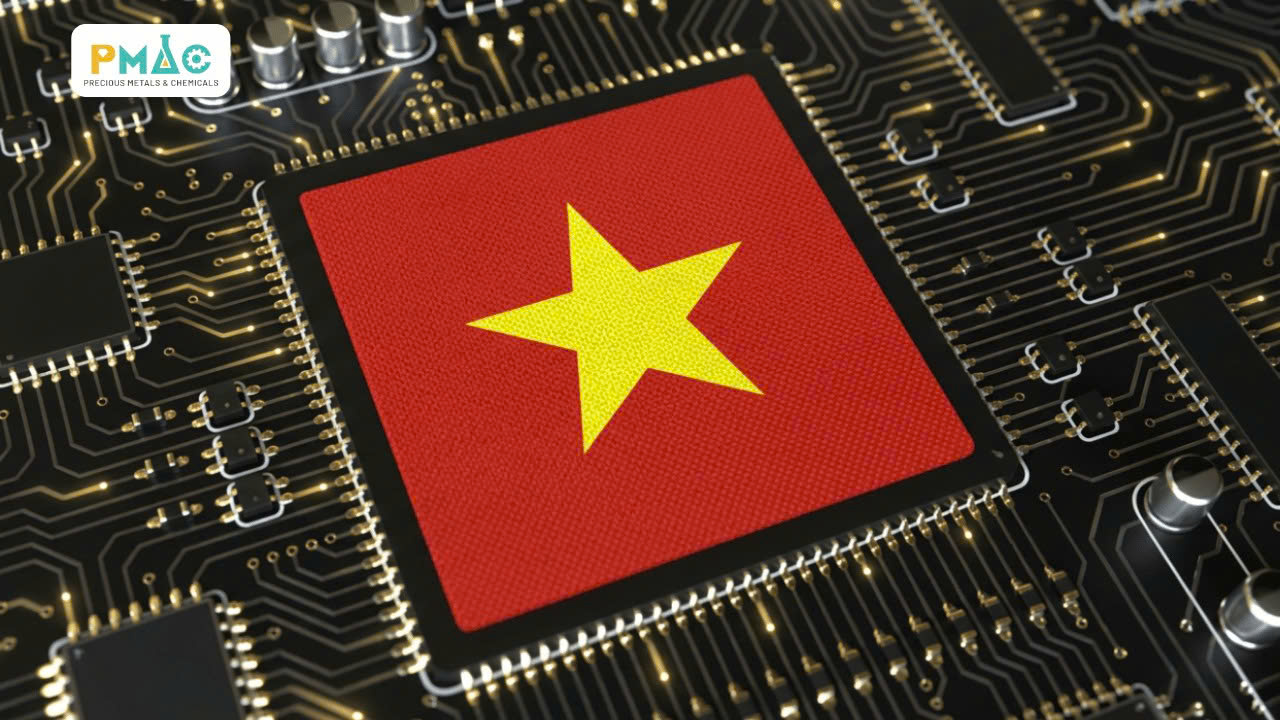
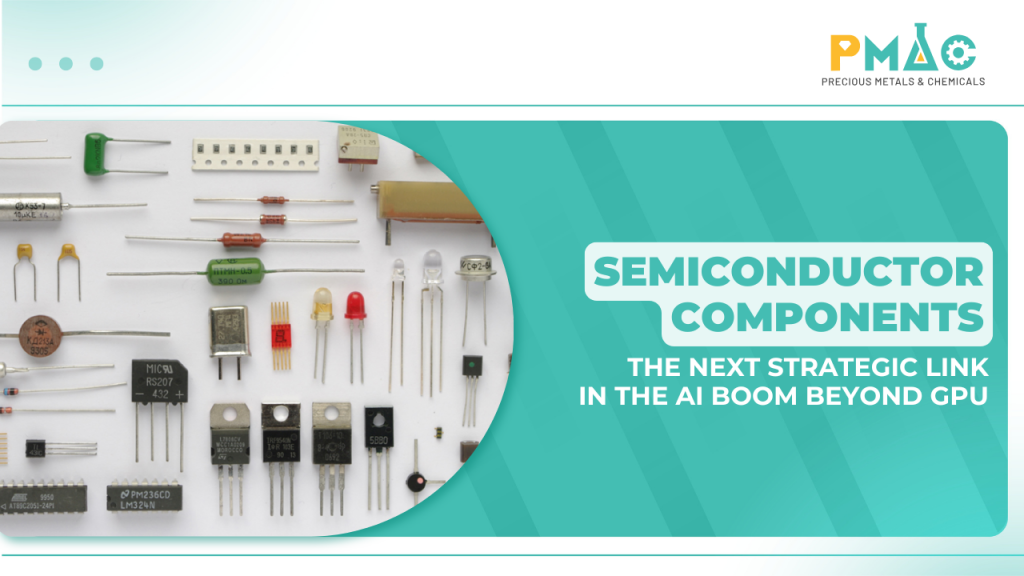
Figure 1. Vietnam is accelerating the development of its domestic semiconductor supply chain. Source: Ministry of Science and Technology.
I. Having a Factory in Vietnam Does Not Mean the Supply Chain Is Also in Vietnam
Global semiconductor companies typically rely on supplier networks that have been built and validated over many years. When opening a new factory in another country, they do not necessarily replace their existing sources of chemicals, materials, or components. If a supplier in Japan, South Korea, Taiwan, or the United States has already demonstrated consistent quality and reliability, continuing to work with that supplier often carries less risk than switching to a new one.
This is also one of the gaps Vietnam still needs to address. The Ministry of Science and Technology has pointed out that Vietnam continues to lack a specialized supply chain for semiconductor materials and logistics. SEMI has likewise described 2026 as a period in which Vietnam needs to move beyond attracting investment and focus on developing a more mature local supply chain.
Therefore, advantages such as “manufactured in Vietnam” or “shorter delivery times” may help local companies approach potential customers, but they are not enough to replace an already approved supplier.
II. The Real Barrier Lies in Semiconductor Supplier Standards
1. One Qualified Sample Does Not Prove Supply Capability
In the semiconductor industry, customers do not only want to know whether one sample meets specifications. What matters more is whether the supplier can reproduce the same level of quality across dozens or hundreds of production batches.
TSMC requires material suppliers to control process stability using statistical methods, manage process changes, and maintain quality management systems. The company also evaluates suppliers based on quality, delivery, cost, service, and sustainability.
This creates a major distinction between “having a suitable product” and “being qualified as a supplier.” The product is only the starting point; the operating system behind it determines whether a company can go further.
2. Every Change Must Be Controlled
A seemingly minor change, such as switching a raw material source, adjusting a formulation, or replacing production equipment, can affect material properties. In processes with extremely tight tolerances, these variations can ultimately influence yield or product reliability.
This is why change control plays such an important role in semiconductor supplier management. In its incoming material quality management, TSMC includes quality system assessment, on-site audit, process change control, excursion prevention, and process variation control as key supplier management responsibilities.
For companies seeking to enter this supply chain, the question is not simply, “Is the current product good enough?” It is also: “If the process changes tomorrow, how will the company control that change?”
3. Quality Must Be Proven With Data
In high-tech manufacturing, simply claiming that “quality is stable” is not enough. Customers need batch records, analytical results, inspection data, and traceability whenever an abnormality occurs.
Intel requires suppliers to provide material declarations for supplied products, including information related to regulations such as RoHS and other chemical and material requirements. Samsung also requires suppliers to control hazardous substances in products and raw materials and to use accurate analytical methods when verifying substance content.
Therefore, a LAB is not merely a place for checking finished products. For a technical supplier, it is also where the data is generated to prove that the process remains under control.

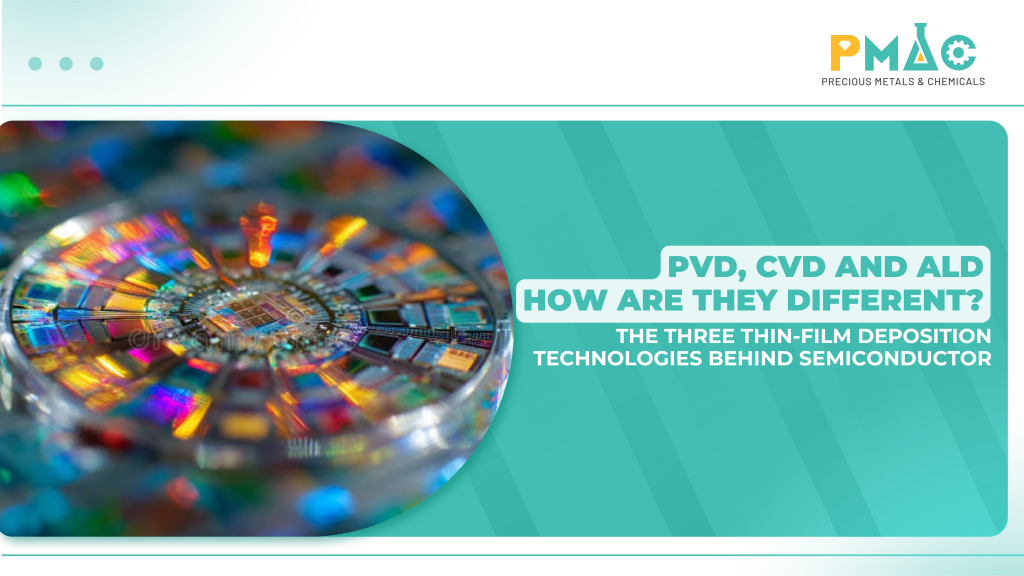
Figure 2. Quality, traceability, and material control are critical factors in the semiconductor supply chain.
PMAC has explored the role of materials, technical documentation, and incoming material control in greater detail in Semiconductor Plating Materials: New Opportunities for PMAC.
4. Suppliers Must Also Meet ESG and Audit Requirements
Supplier standards today go beyond product quality. Intel requires suppliers to report on responsible labor practices, minerals, chemicals, and environmental footprints. Samsung applies a Supplier Code of Conduct based on standards such as those of the Responsible Business Alliance and conducts self-assessments, on-site audits, third-party audits, and follow-up improvement programs.
This is particularly important for companies supplying chemicals, metals, or materials. Raw material origin, hazardous substances, production conditions, and downstream supply chain management may all become part of the assessment process.
In other words, ISO and ESG are not simply elements to display in a corporate profile. When entering a high-tech supply chain, they must be reflected in real operating systems that can withstand an audit.
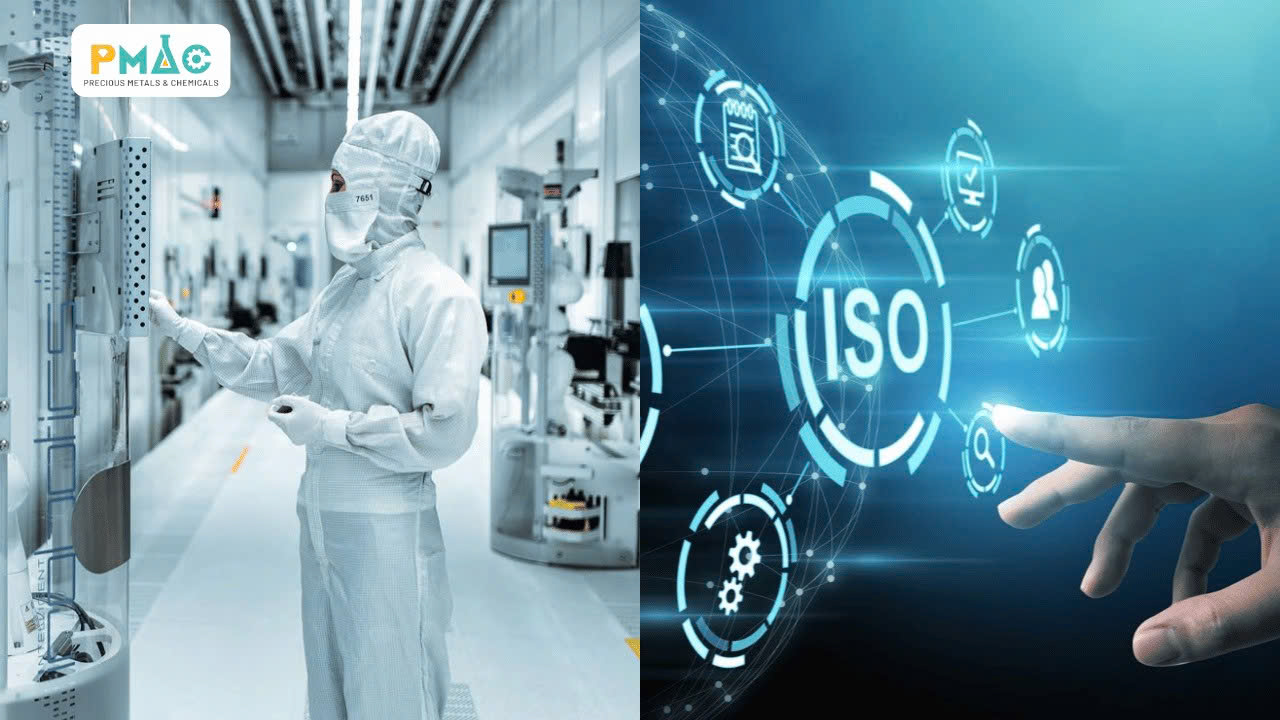
Figure 3. Semiconductor suppliers must manage quality according to strict international standards.
III. The Real Key Is the Supplier Qualification Process
One common misconception is that once a company has a suitable product and gains access to the purchasing department, it is already close to receiving an order. In reality, for inputs that can affect production quality, the process that follows is often much longer.
Each corporation has its own procedures, but the supplier management systems of Intel, TSMC, and Samsung reveal a common logic: companies are assessed on their products, management systems, technical capabilities, and compliance, and then continue to be monitored throughout the supply relationship. This is an inference based on how these companies publicly describe their supplier management and audit practices, rather than a fixed process applied to every factory.
A typical process can be understood as:
Technical assessment → Sample testing → System assessment → Audit → Process trial → Quality monitoring → Supplier approval
The challenge is that a new supplier must do more than prove its product meets requirements. It must also create enough confidence for the customer to accept the risk and cost of introducing an additional source into the production line.
This is why a lower price is not necessarily the deciding advantage. A new supplier may differentiate itself through faster response times, local technical support, problem-solving capabilities, supply stability, or stronger analytical capabilities. Intel also evaluates suppliers not only on quality, but on factors such as performance, innovation, collaboration, and continuous improvement.
IV. What Should Vietnamese Companies Prepare Before Approaching a Semiconductor Factory?
Instead of starting with a lengthy catalogue, companies should begin by demonstrating one clearly defined capability. This may be the ability to maintain consistent quality for a specific material, provide reliable analytical data, or solve technical problems more quickly through an engineering team based in Vietnam.
The next step is to standardize systems before customers request it. Batch records, equipment calibration, change control, raw material management, and LAB data should be integrated into day-to-day operations rather than prepared only when an audit is approaching.
More importantly, companies need to shift from a mindset of “selling a product” to “solving a technical problem.” A high-tech factory does not simply need a supplier that delivers on time. It needs a partner that can respond when specifications change, collaborate in root-cause analysis when problems arise, and provide sufficiently clear data to support decision-making.
This is also why PMAC approaches the semiconductor industry through specific issues related to materials, process control, and technical data rather than focusing only on investment figures. For foundational knowledge about the role of packaging, see What Is Semiconductor Packaging?, while the chip testing process is discussed in What Is Semiconductor Testing?.
Conclusion
The presence of 241 projects and more than US$14.2 billion in FDI demonstrates Vietnam’s growing attractiveness to the semiconductor industry. However, an ecosystem is not created simply by placing many factories within the same country. It becomes deeper only when the businesses surrounding those factories can meet the global supply chain’s requirements for quality, data, consistency, and compliance.
Vietnam’s next challenge is therefore not simply how many more billions of dollars in investment it can attract. The harder challenge is turning the presence of FDI into real capabilities among domestic suppliers. That may be the true dividing line between being close to the supply chain and actually becoming part of it.
PMAC Joint Stock Company
Ho Chi Minh City Office:
4th Floor, HUTECH Building, D1 Road, Saigon Hi-Tech Park, Tang Nhon Phu Ward, Ho Chi Minh City, Vietnam
Hanoi Office:
22B O2, Linh Dam Peninsula, Hoang Liet Ward, Hanoi, Vietnam
Hotline: +84 387 235 878
Facebook: PMAC